Understand your requirement
Review the component drawings, normal geometry and supplier variation, normal bulk supply and required assembly orientation. Identify sealing faces, mesh or media that must not be touched or marked.
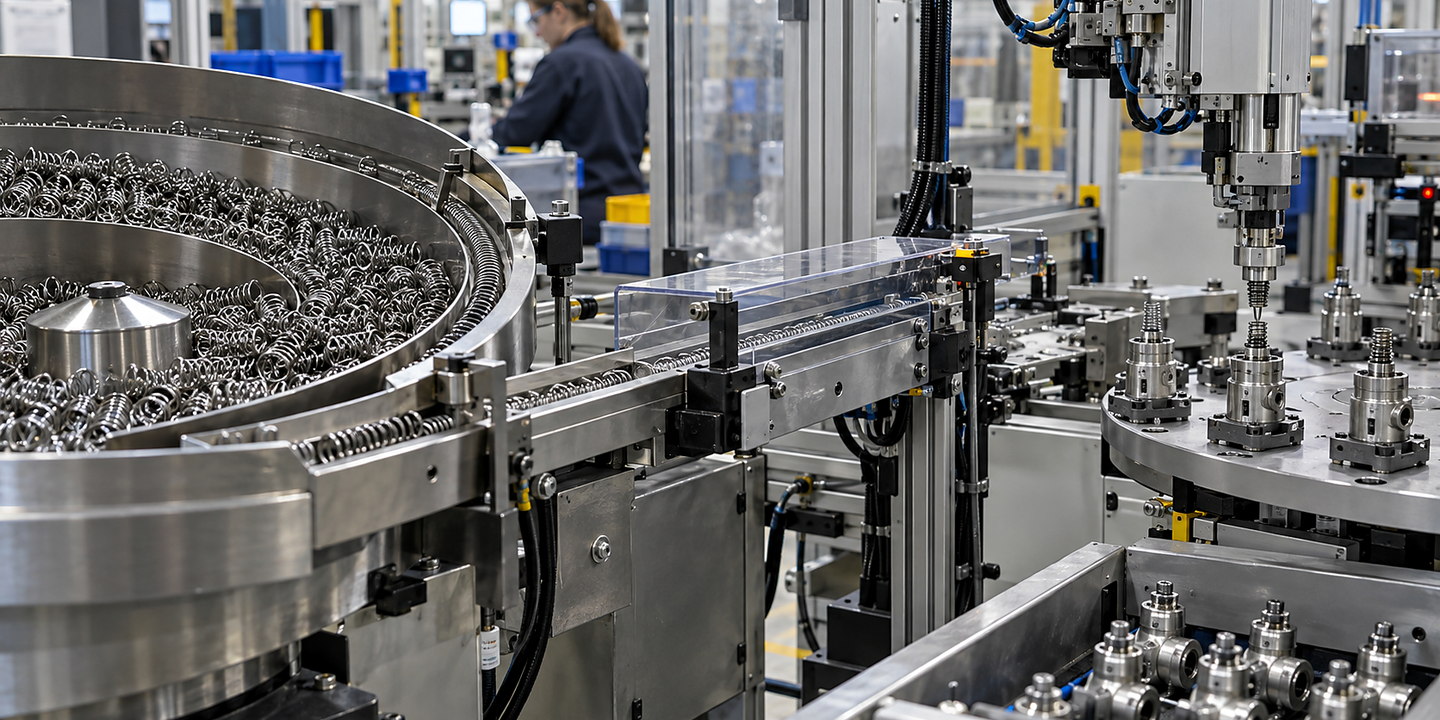
Compare filter-component presentation routes using protected sealing faces, mesh or media, representative bulk trials, nested parts and usable assembly delivery.
Compare each proposed presentation route using the same filter-component range, normal bulk supply, final assembly orientation and protected-surface limits. Trial separation, transfer and the actual downstream interface together. Retain before-and-after condition checks, usable delivery, jams and the documented recovery for an incorrectly presented component.
Use the same acceptance evidence for each route and protected-feature specification. Fragile or otherwise unsuitable components may need a different presentation method; no route should be accepted solely from a quoted feeder output.
Plan filter component feeders around real component variation, bulk condition, orientation, usable delivery rate and the downstream interface. Discuss representative part trials with Sorting Solutions. When you compare solutions, check how each option handles component geometry and variation for filter-component presentation & feeding, surface, fragility and entanglement behaviour and your surrounding line.
Discuss your application

Review the component drawings, normal geometry and supplier variation, normal bulk supply and required assembly orientation. Identify sealing faces, mesh or media that must not be touched or marked.
Use representative components and nested examples to compare the proposed separation and transfer route. Apply the same before-and-after protected-feature check and record usable downstream delivery and incorrect presentation.
Resolve the escapement, downstream pick or assembly interface, controls and authorised access with the component-condition limits visible in the brief. Assess the final handover rather than treating the feeder exit as the accepted result.
Agree separate records for usable delivery, jams, damage, incorrect presentation and recovery. Retain the identified settings and component range, operating information and first accepted result after the documented recovery.
Typical support: sample assessment, feeding trials, orientation tooling, controls, escapement and line integration.
| Approach | Often suitable when | Watch for |
|---|---|---|
| Filter Component Feeders | You need a dedicated solution for a clearly defined duty, product or part range and line interface. | Sample trials must include normal, marginal and supplier-variant components. |
| Flexible Vision-Guided Feeding for Suitable Variable Part Families | Compare a proposed route for the actual variable component family through representative trials. | Verify separation, orientation, transfer and protected-feature condition with normal, marginal and nested examples. |
| Manual or Tray Presentation where Bulk Feeding Would Damage Parts or Add Unjustified Complexity | Compare this route where a proposed bulk-feeding method conflicts with protected features or adds unjustified complexity. | Include actual handling tasks, assembly orientation, handover and before-and-after component condition in the comparison. |